Terms Relating to Web Hosting (Series G, H, I)
Gateway – A connection between two or more networks. The connection may be between physical…

 Serena
Need to extract a ZIP file without touching your mouse? Windows gives you four solid ways to unzip from the command line no third-party tools required for most cases. This guide covers all of them, from the simplest one-liner to batch extraction and password-protected archives.
Windows includes a built-in tar command, so you can extract standard ZIP archives without installing additional software.
Basic extraction (same folder)
Open Command Prompt, navigate to the folder containing your ZIP file, and run:

The files will be extracted into the current directory.
Extract to a specific destination folder
Use the -C flag followed by the destination path:

i: The destination folder must already exist. If it doesn’t, create it first with mkdir “C:\path\to\folder,” then run the tar command.
1. Open Command Prompt. Right-click the Start menu and select Terminal (Admin) or Command Prompt (Admin).
2. Navigate to the ZIP file location using the cd command:
cd C:\Users\YourName\Downloads
3. Run the extraction command. Replace filename.zip with your actual file name:
tar -xf filename.zip
4. Done. The contents appear in the same folder. No confirmation message is shown on success; that’s normal.
Useful tar flags:

PowerShell’s Expand-Archive cmdlet is the most flexible native option, with better path handling and the ability to overwrite existing files.
Basic syntax

Common usage examples
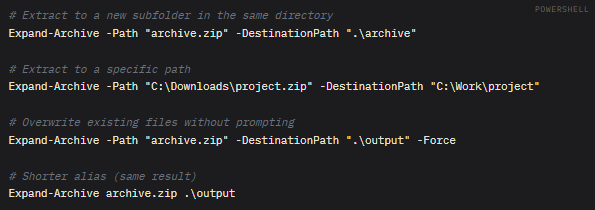
PowerShell creates the destination folder automatically if it doesn’t exist — unlike tar, which requires the folder to exist first.
Press Win + X and choose Terminal or Windows PowerShell. On Windows 11, PowerShell is the default terminal. You can also type PowerShell directly into the CMD window.
Check PowerShell version (required: 5.0+)
Expand-Archive requires PowerShell 5.0 or later. To check:
$PSVersionTable.PSVersion
All modern Windows 10 and Windows 11 systems have PowerShell 5.1 or later installed by default.
Windows has no built-in support for .7z archives. To handle them from the command line, install 7-Zip (free and open-source), which also installs a command-line executable.
Step 1 — Install 7-Zip: Download the installer from 7-zip.org and install it. The default installation path is C:\Program Files\7-Zip\.
Step 2 — Add 7-Zip to your PATH: This lets you call 7z from any folder in CMD. If you skip this, prefix every command with the full path “C:\Program Files\7-Zip\7z.exe”.
Step 3 — Extract the archive
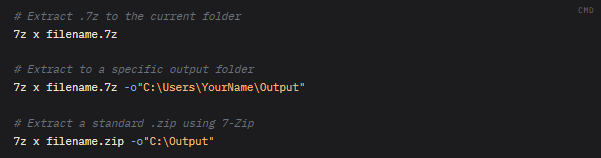
i Note: there is no space between -o and the path. Writing -o “C:\Output” with a space will cause an error.
7-Zip command reference

7-Zip works with ZIP, 7z, TAR, GZ, RAR, ISO, and many other formats, making it the most versatile command-line extraction tool on Windows.
Windows’ built-in tar command does not support password-protected archives. For this, you need either 7-Zip or PowerShell with the right module.
Using 7-Zip (recommended)

Not sure which method to use? Here’s a quick reference:
| Method | Needs installation? | ZIP | .7z / RAR | Password | Best for |
|---|---|---|---|---|---|
| tar (CMD) | No | ✓ | ✗ | ✗ | Quick ZIP extraction, no setup |
| Expand-Archive | No | ✓ | ✗ | ✗ | Scripting, batch jobs, and auto-create folders |
| 7-Zip (7z) | Yes (free) | ✓ | ✓ | ✓ | All archive types, passwords, and advanced use |
Error: tar: Error opening archive: Failed to open
Cause: The file path is wrong, or the file doesn't exist in the current directory.
Fix: Run dir to list files in the current folder and confirm the exact filename and extension. Use cd to navigate to the correct folder first.
Error: Access is denied
Cause: CMD or PowerShell is not running with Administrator privileges.
Fix: Close the terminal and reopen it by right-clicking and selecting Run as administrator.
Error: Expand-Archive: The path already exists
Cause: Files from a previous extraction already exist in the destination folder.
Fix: Add -Force to the command to overwrite existing files: Expand-Archive -Path file.zip -DestinationPath .\output -Force
Error: tar is not recognized as an internal or external command
Cause: Your Windows version predates the tar integration (pre-Windows 10 build 17063).
Fix: Update Windows 10 to a recent version, use PowerShell's Expand-Archive instead, or install 7-Zip.
Archive extracts, but files appear corrupt or incomplete
Cause: The ZIP file itself may be corrupt, or the download was interrupted.
Fix: Re-download the file. To verify archive integrity with 7-Zip before extracting: 7z t filename.zip
Once you’ve extracted your files, you can compress them again using the same tar command. Here’s how: [How to Zip Files via Command Prompt]

Explore more hosting insights, tips and industry updates.
Gateway – A connection between two or more networks. The connection may be between physical…
In this article, you will learn how to check the size of MySQL databases and…
This article is about HTT2 and how you can enable HTT2 in WHM What is…