What is EPP Code where can I find it?
The EPP key is authorization code. It is one of the protection against unauthorized movement…

 Serena
In this article, we have explained what is the difference between a website, a domain name, and a URL. Terms like “website,” “domain name,” and “URL” are commonly used when browsing the internet. These terms, however, have different meanings and are not interchangeable. Anyone working in web development, hosting, or internet usage, in general, has to be aware of the distinctions between them.
Let’s take a look ahead:
Website A website is an internet-accessible collection of digital content and web pages maintained on a server. It is constructed with back-end frameworks like PHP, Python, or Node.js, frequently in conjunction with technologies like HTML, CSS, and JavaScript. Personal blogs, e-commerce sites, business websites, or any other type of online presence are all considered websites.
For example: Google, Amazon, and Wikipedia are websites.
Domain Name The domain name is the human-readable address that accesses a website. It acts as an identifier that points visitors to the hosting server for the website. Users would need to memorize numerical IP numbers to access websites in the absence of domain names.
Example: In “www.sample.com,” the domain name is “sample.com.”
Domain names consist of different levels:
URL (Uniform Resource Locator) The URL is the web address that finds a specific resource on a website. Several parts make up a URL.
Example: https://www.sample.com/blog/article.html
Components of a URL:
Key Differences
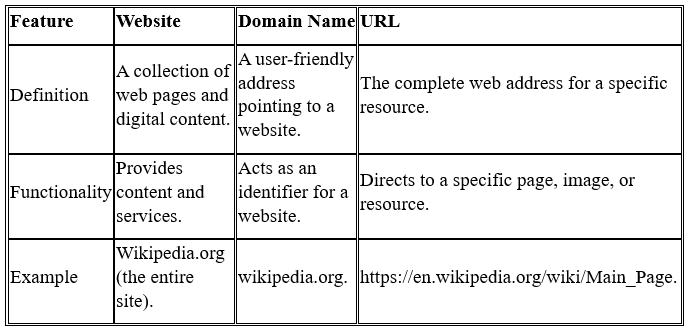 Understanding the difference between a website, a domain name, and a URL is essential for web users and professionals. The domain name is the website’s address, the website hosts actual content on a server, and the URL provides the full web address leading to specific resources within a website. Each component plays a crucial role in web navigation and accessibility.
Read more: What Clearly is a Domain Name Status?

Explore more hosting insights, tips and industry updates.
The EPP key is authorization code. It is one of the protection against unauthorized movement…
In this article, learn to install a free Let’s Encrypt SSL Certificate for a domain…
Few of the Signs and Symptoms: You may be asked for FTP link information while…