
Best Online Security Tips for Small Businesses
Why care about small business network security? You might consider your business to be too…

 Paul Lopez
A strong online presence depends on more than simply publishing content and waiting for search traffic to grow. Websites need useful content, relevant backlinks, solid technical foundations, and a clear structure to compete effectively in search results. Domain Authority (DA) is one metric SEO professionals use to evaluate the relative strength of a website and compare it with competitors.
However, improving your DA score should not be the only objective. DA is a third-party SEO metric and does not directly determine your position in Google Search. The real goal is to strengthen the factors that support a healthy website and better organic visibility. In this guide, we explain practical ways to improve Domain Authority while building a stronger foundation for search engine rankings.
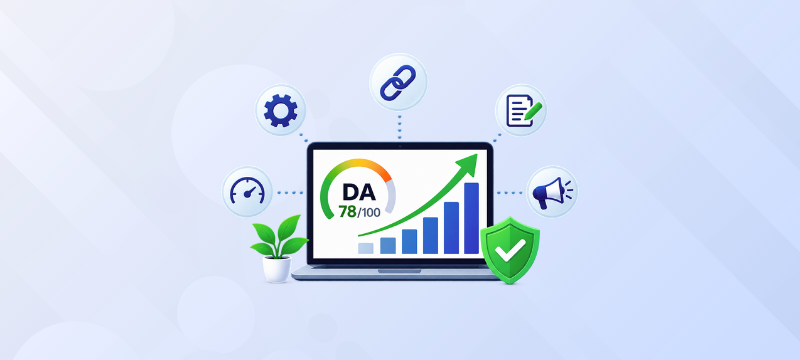
Domain Authority is a score developed by Moz to estimate a website’s ranking strength relative to other websites. The score ranges from 1 to 100, with higher scores generally representing a stronger backlink profile and greater potential to compete in search results.
It is important to understand that DA is not a score provided or used directly by Google. Google has its own ranking systems that evaluate pages using many different signals. Therefore, a website with a lower DA can still outrank another website with a higher DA if its content is more relevant, useful, and better suited to the search query.
DA is most useful as a comparison and diagnostic metric. For example, you can compare your website with competitors in the same industry to understand the relative strength of your domain and backlink profile.
Checking Domain Authority is relatively simple. Moz provides tools that allow website owners and SEO professionals to review their DA score and backlink information.
You can check your score by following these steps:
Other SEO platforms also provide their own authority-related metrics. Ahrefs, for example, uses Domain Rating (DR), while other SEO tools use different scoring systems.
These metrics are calculated differently, so avoid comparing scores from different platforms as though they were identical. Use one tool consistently when monitoring changes over time.
Improving Domain Authority is not something that happens overnight. More importantly, there is no single SEO activity that guarantees a higher score. A stronger website usually comes from several improvements working together.
Backlinks remain an important part of building a strong website authority profile. When relevant and reputable websites link to your content naturally, those links can help search engines understand connections between websites and pages. Focus on earning links rather than simply increasing the number of backlinks. Create useful resources, original research, detailed guides, statistics, tools, or industry insights that other websites have a genuine reason to reference.
Avoid buying backlinks or participating in link schemes designed primarily to manipulate rankings. A smaller number of relevant, trustworthy links can be more valuable than a large collection of unrelated or artificially created links.
Content should give visitors a clear reason to stay on your website. Instead of writing articles only around keywords, focus on answering the questions your audience actually has. Before creating a page, consider what problem the reader is trying to solve and what information would help them make a decision. Include practical examples, useful explanations, original insights, and accurate information wherever appropriate.
Keep your content updated when products, technologies, statistics, or recommendations change. Strong content should be useful even when a visitor reaches it directly rather than through a search engine. Google recommends creating helpful, reliable, people-first content rather than content produced primarily to manipulate search rankings.
On-page SEO helps search engines and visitors understand what each page is about. Review important elements such as title tags, headings, URLs, internal links, image alt text, and the main content. Use relevant terms naturally throughout the page instead of repeatedly inserting the same keyword. Your headings should clearly describe the information that follows, while the title should accurately represent the page.
Also consider search intent. Someone searching for “best VPS hosting” may be comparing services, while someone searching for “how to connect to a VPS” is looking for instructions. Matching the content to the user’s purpose can make the page more useful.
Internal links connect different pages within your website. When used properly, they make it easier for visitors to discover related information and help search engines understand how your content is organized. For example, a blog about website security could naturally link to related content about SSL certificates, malware protection, backups, or secure hosting.
Use descriptive anchor text that gives readers an idea of what they will find after clicking. Avoid adding internal links simply to increase the number of links on a page. A well-planned internal linking structure can also help important pages receive more visibility within your website.
Review your backlink profile periodically to understand which websites are linking to your content. Look for unusual patterns, clearly manipulative links, or backlink activity that you did not create intentionally. However, do not assume that every low-quality or irrelevant backlink is harmful. Website owners do not need to remove or disavow every backlink they consider undesirable.
If there is a serious link-related issue, particularly one involving unnatural links, investigate the situation carefully before taking action. Google’s disavow tool is intended for specific circumstances and is not a routine requirement for every website. The better long-term approach is to focus on earning relevant links and avoiding practices that attempt to manipulate search rankings.
Even strong content can struggle if search engines have difficulty accessing or understanding your website. Regular technical SEO checks can help identify problems that may affect crawling, indexing, and user experience. Review your website for broken links, incorrect redirects, duplicate pages, indexing problems, missing important pages, and mobile usability issues. Make sure important content is accessible to search engines and users.
Also keep your website secure with HTTPS and monitor page performance. Technical SEO is not about making your website complicated; it is about removing unnecessary barriers that can affect accessibility and usability.
Older content can lose value when information becomes outdated. Statistics change, products are discontinued, technologies evolve, and recommended practices may no longer apply. Review your important pages regularly and update information where necessary. Replace outdated statistics, check external references, update screenshots, remove obsolete recommendations, and add useful information that has become relevant since the page was originally published.
Do not update content simply to change the publication date. Make meaningful improvements that make the page more useful for visitors. Freshness can be particularly important for topics where information changes frequently, while evergreen topics may require updates less often.
A recognizable brand can make it easier for people to remember and return to your website. Publish useful content consistently and promote it through channels where your target audience is active. Industry publications, communities, partnerships, email campaigns, social platforms, and expert contributions can help your content reach new audiences. The objective is not simply to collect social shares, but to introduce valuable content to people who may find it useful. Over time, strong content and brand visibility can create opportunities for natural mentions, referrals, and backlinks.
There is no single DA score that can be considered good for every website. A DA of 40 may be competitive in one industry but relatively weak in another. Instead of setting an arbitrary target, compare your website with direct competitors that target similar audiences and keywords. If your competitors have significantly stronger authority profiles, review their referring domains, content strategies, and link-earning approaches.
Remember that DA is a comparative metric. A gradual improvement in your website’s authority can be useful, but it should not become the main objective of your SEO campaign.
No. Domain Authority does not directly affect Google rankings because it is a third-party metric created by Moz. Google uses its own automated ranking systems to evaluate pages and determine which results are relevant and useful for individual searches. Google also explains that ranking happens primarily at the page level using multiple signals and systems.
This is why a website with a lower DA can rank above a website with a higher DA. The page’s relevance, usefulness, content quality, links, and other signals can all influence how it performs for a particular search. Therefore, increasing DA should be viewed as an indication of improving your website’s overall authority profile, not as a guaranteed method for improving rankings.
Do not use Domain Authority as your only performance metric. A broader set of measurements provides a better picture of whether your SEO strategy is working.
Track metrics such as:
Google Search Console can help you monitor search impressions, clicks, and query performance, while analytics platforms can provide additional information about user behavior and conversions. If your DA increases but organic traffic and conversions remain unchanged, there may be other areas of your SEO strategy that require attention.
Improving Domain Authority is a long-term process that involves more than building backlinks. A stronger website requires useful content, relevant links, sound technical SEO, clear internal linking, and a positive user experience. Remember that Domain Authority is a third-party comparison metric, not a Google ranking score. Instead of chasing a specific DA number, focus on building a website that provides genuine value and earns references from reputable websites.
Choosing bodHOST Web Hosting Services provides the reliable infrastructure needed to support website performance, security, and stability as your online presence grows.
Learn more in our detailed article: SEO Trends 2026 Explained: Top Strategies to Boost Rankings

Explore more hosting insights, tips and industry updates.
Why care about small business network security? You might consider your business to be too…
There are many hosting plans in the web hosting market. Such as, shared hosting, VPS…
After a recent news update featuring a study wherein approximately 48% Americans want to be…