
Top-6 Website Security Practices That Businesses Must Follow
For any web business, their website is the most prominent digital asset, as well as…

 Paul Lopez
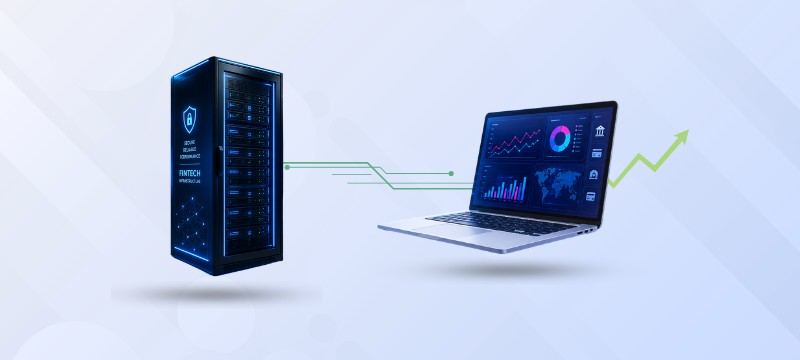
FinTech businesses rely on fast, secure, and reliable infrastructure to manage financial data, transactions, and customer information. Applications such as payment gateways, trading platforms, digital finance tools, and financial analytics can place significant demands on hosting environments.
Dedicated servers provide exclusive CPU, RAM, storage, and network resources, giving businesses greater control over performance and security. They can also support customized configurations and predictable resource availability for demanding workloads. In this guide, we explore why FinTech companies choose dedicated servers, when they may not be the right fit, and what to consider when selecting the best infrastructure for financial applications.
A dedicated server is a physical server assigned to a single organization rather than shared between multiple customers. For FinTech businesses, this provides greater control over computing resources, security configurations, operating systems, and application environments.
Financial applications often handle sensitive information, frequent transactions, large datasets, and time-sensitive operations. A dedicated environment can provide predictable performance because CPU, RAM, storage, and network resources are not shared with unrelated workloads. This makes dedicated servers suitable for applications where consistent performance and infrastructure control are important.
FinTech platforms have different infrastructure requirements from ordinary business websites. Payment systems, financial analytics platforms, trading applications, and banking software may need strong security, reliable performance, and carefully configured infrastructure.
A dedicated server gives a business complete physical resource isolation. Since other customers do not use the same server, organizations have greater control over security policies, access permissions, firewall configurations, and installed software. This isolation can be particularly useful when applications process sensitive financial or customer information.
FinTech businesses often operate under industry-specific regulations and internal security policies. Dedicated infrastructure can make it easier to configure systems according to organizational requirements, including access controls, logging, data protection, and server-level security policies. However, a dedicated server alone does not guarantee regulatory compliance. Businesses must also follow applicable legal, security, and operational requirements.
Some financial applications depend on quick processing and consistent network performance. Trading platforms, payment systems, and real-time analytics can benefit from dedicated CPU, memory, and network resources. Choosing a server location close to users, financial exchanges, or application dependencies can also help reduce network latency.
FinTech applications often require specialized software. Dedicated servers offer greater freedom to select operating systems, configure applications, install required software, and adjust server settings to meet workload requirements. This flexibility is useful for businesses that need customized environments rather than standardized hosting configurations.
Financial applications cannot always afford extended interruptions. Dedicated infrastructure can be combined with backups, redundant systems, monitoring, failover mechanisms, and disaster recovery strategies to improve business continuity. The server itself is only one part of a high-availability strategy, but it can provide a dependable foundation for critical workloads.
Choosing between dedicated, VPS, and cloud infrastructure depends on the application’s workload, budget, scalability requirements, and control requirements.
| Feature | Dedicated Server | VPS Hosting | Cloud Hosting |
|---|---|---|---|
| Resource Isolation | Complete | Virtualized | Flexible allocation |
| Performance | Consistently high | Good | High and scalable |
| Scalability | Hardware-based | Plan-based | Highly flexible |
| Customization | Very high | High | High |
| Security Control | Extensive | Good | Extensive |
| Cost | Higher | Lower | Varies by usage |
| Best For | Critical workloads | Growing applications | Dynamic workloads |
A dedicated server is generally most suitable when predictable performance and infrastructure control are priorities. VPS hosting can be practical for smaller workloads, while cloud infrastructure is attractive when rapid scalability and distributed resources are important.
Dedicated infrastructure is powerful, but it is not automatically the best option for every FinTech company.
Hardware selection should be based on the application’s actual workload rather than simply choosing the highest available specifications. The CPU determines processing capacity, while RAM supports concurrent applications and database activity. For storage, NVMe SSDs can provide faster read and write performance than traditional storage technologies, making them useful for database-intensive applications. Network capacity is equally important for transaction-heavy workloads.
Server location should also be considered. Hosting infrastructure closer to users and critical services can help reduce network latency and improve application responsiveness.
FinTech applications can benefit from hardware configurations designed around their specific workload. Transaction-heavy platforms may require powerful multi-core processors and sufficient RAM, while analytics applications may prioritize processing capacity and fast storage. Database workloads should receive particular attention because inefficient storage or insufficient memory can become a bottleneck. Network configuration should also be reviewed for applications that process frequent real-time requests.
The goal is not simply to purchase the most powerful server. Instead, businesses should match CPU, RAM, storage, and network resources to application requirements.
Many FinTech companies do not rely on one infrastructure type for every workload. A hybrid approach can combine dedicated servers with cloud or other environments. For example, a business could use dedicated infrastructure for a core financial application while using cloud resources for analytics, development, backups, or temporary workload increases.
This approach provides greater flexibility while allowing sensitive or resource-intensive workloads to remain on controlled infrastructure.
A typical architecture could include a dedicated application server connected to a separate database environment, protected by firewalls and access controls. Load balancing can distribute incoming requests, while monitoring tools track resource usage and system health. Regular backups should be stored separately from the production server. For critical applications, a secondary environment can provide disaster recovery capabilities.
The exact architecture depends on application design, compliance requirements, transaction volume, geographic needs, and recovery objectives.
The main advantage is control. Businesses can customize the server environment around their applications instead of adapting critical workloads to shared infrastructure limitations.
Dedicated servers can also provide predictable resource availability, stronger isolation, flexible configurations, and consistent performance. When combined with appropriate security controls, backups, monitoring, and disaster recovery, they can form a strong infrastructure foundation for demanding financial applications.
Start by identifying your application’s CPU, RAM, storage, bandwidth, security, and geographic requirements. Then compare providers based on hardware quality, data-center locations, network reliability, security capabilities, backup options, monitoring, support availability, and upgrade flexibility. Do not evaluate providers on monthly pricing alone. A cheaper server may become expensive if it lacks required security features, technical support, performance capacity, or recovery options.
It is also important to understand what the provider manages and what remains your responsibility. bodHOST – Managed Dedicated Server provides managed infrastructure and technical support, helping businesses focus on their FinTech applications while server-related tasks are handled by experienced professionals. Clear service agreements can also prevent confusion about responsibilities, support coverage, and technical issues.
FinTech applications require infrastructure that can balance performance, security, flexibility, and reliability. Dedicated servers can be a strong choice for businesses handling demanding workloads, sensitive information, and business-critical financial processes, particularly when predictable resources and greater infrastructure control are required.
The right configuration should always be based on the application’s workload, security requirements, expected growth, and recovery objectives. bodHOST provides dedicated server solutions with customizable resources and infrastructure options that can help FinTech businesses build a reliable foundation for demanding applications while supporting their evolving technology needs.
Learn more in our detailed article: 5 Reasons AI-Driven Businesses Need Dedicated Servers

Explore more hosting insights, tips and industry updates.
For any web business, their website is the most prominent digital asset, as well as…
If you want your WordPress website to stand out in search results in 2026, adding…
Practices to reduce IT operating costs: This blog post shows how a company can reduce…